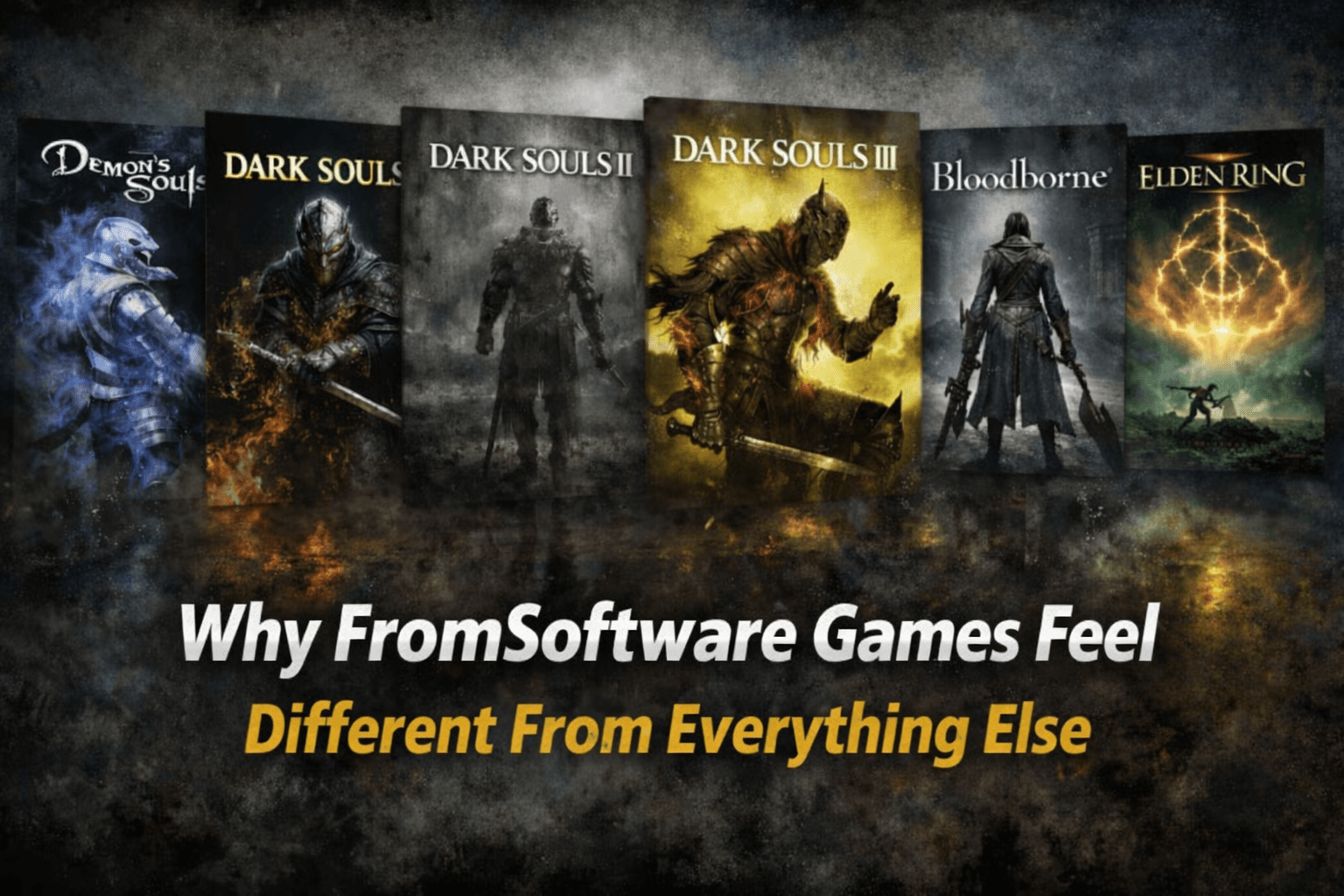
Why FromSoftware Games Feel Different From Everything Else
I've been gaming since I was six years old. I've played hundreds of games across every genre. And I can say with complete confidence that no studio makes me feel the way FromSoftware does.
Not scared. Not frustrated — well, okay, frustrated sometimes. But something else entirely. Something harder to name.
It took me a long time to figure out what that feeling actually is. And I think I finally have an answer.
The World Doesn't Care About You
Most games are built around the player. The story revolves around your character. NPCs react to your presence. The world bends to accommodate your journey. You are, in the most literal sense, the chosen one.
FromSoftware games don't do that.
In Dark Souls, you are an Undead. A hollow. You're not special — you just happened to not die permanently yet. The world of Lordran existed long before you arrived and will exist long after you're gone. The lore isn't explained to you. It's buried in item descriptions, in environmental details, in things characters say that don't quite make sense until your third playthrough.
The world has a history. You're just passing through it.
That's rare. That's genuinely rare in games. And it creates something most games never achieve: the feeling that you're discovering a place, not experiencing a narrative designed for you.
Difficulty as Communication
Everyone talks about how hard FromSoftware games are. And yes, they're hard. But the difficulty isn't the point — it's the method.
When a boss kills you fifteen times, you're not just failing. You're learning. Every death is information. The Dancer of the Boreal Valley doesn't kill you because the game is cruel. She kills you because you haven't learned her rhythm yet. When you finally beat her, you haven't just pressed the right buttons — you've genuinely understood something about how she moves.
That's teaching through experience in its purest form.
Compare that to most games, where difficulty means enemies have more health and deal more damage. There's nothing to learn there. You just need better numbers. FromSoftware difficulty is a language, and dying is how you learn to read it.
Silence as Storytelling
Miyazaki — Hidetaka Miyazaki, the creative director behind most of these games — has talked about how his approach to storytelling was shaped by not being able to fully read the English fantasy novels he loved as a child. He'd fill in the gaps with his imagination. He thought that gap-filling was actually more powerful than being told everything directly.
That philosophy is everywhere in his games.
Sif, the Great Grey Wolf in Dark Souls, has almost no cutscene. You fight her. As her health drops, she starts limping. She puts herself between you and the ring you need. She's protecting her dead master's grave. The game tells you none of this explicitly. You piece it together. And because you pieced it together yourself, it hits harder than any cinematic ever could.
The Community That Builds Around It
There's something else FromSoftware games do that I don't think is accidental: they create communities.
Because the lore is hidden, players dig. Because the world is mysterious, people share discoveries. The Prepare to Die subreddit, the wikis, the YouTube channels dedicated entirely to lore — none of that exists without intentional design choices that leave things unexplained.
When you play Elden Ring, you're not just playing a game. You're joining a conversation that's been happening since it launched. What does the Erdtree really represent? Who was Marika before she became a god? Why does Melina burn herself?
Nobody fully agrees. And that's the point.
Why Nobody Else Can Copy It
Every few years, a studio tries to make a "Soulslike." Some of them are genuinely great — Lies of P and Hollow Knight come to mind. But none of them feel quite the same.
I think it's because the formula isn't what makes FromSoftware special. It's the intentionality behind every choice. The world-building and the gameplay and the difficulty and the silence all serve the same purpose: to make you feel small in a world that is vast and strange and indifferent to your existence.
That feeling — of being small but persistent — is what keeps people coming back.
It's not masochism. It's something much closer to wonder.
And there's nothing else in gaming quite like it.
Comments (0)
Join the conversation
No comments yet. Be the first!